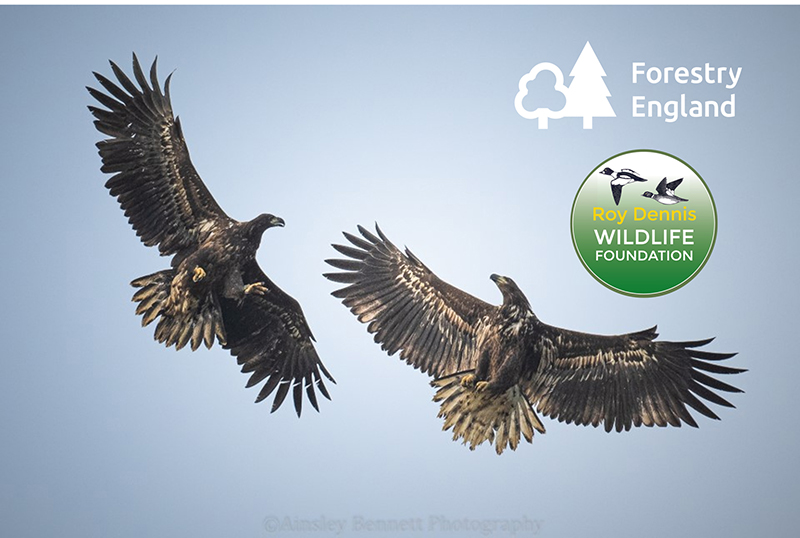
 Do join us for a talk on Wednesday 28th October by Imogen Lloyd from Forestry England about the fascinating White-tailed Eagle reintroduction with the project centred on the Isle of Wight. The project started in 2019 and is led in partnership by Forestry England and the Roy Dennis Wildlife Foundation, licensed by NatureScot and Natural England. Imogen will cover the ecology of White-tailed Eagles, their history in the British Isles and bring us up to speed with the latest exciting updates from the project.
All welcome, Froyle Village Hall doors open 6.30pm, Froyle Wildlife AGM pictorial review starts 7pm, reintroduction talk starts 7.30pm, entrance free for members, £3 non-members, teas and coffee.
The RSPB website says ‘In 1918, the last-known White-tailed Eagle in the UK was shot and killed. These birds of prey didn’t breed on our shores for over 60 years. That could have been the end of the story. But due to a few dedicated people, it wasn’t. The return of the White-tailed Eagle to the UK is a tale of determination: and one of nature’s greatest comebacks. It’s a 50-year story of resilience and restoration, and eventual success’.
A passing white-tailed eagle has even been photographed in Froyle! See the photos.
Summary of the talk: We welcomed Imogen Lloyd of Forestry England who gave us a fascinating talk about the Isle of Wight-based White-tailed Eagle reintroduction project. These eagles are Britain’s largest bird of prey which were widespread across England until persecution by humans wiped out all 1,500 breeding pairs by 1780. Imogen is part of the current project team with first-hand experience of releasing these amazing birds in southern England and monitoring their activities and feeding habits post-release.
Also known as sea eagles, the white-tailed eagle is unmistakable, largely due to its size; an adult stands 90cm tall and has an 8-foot wingspan. However, its distinctive white tail does not fully develop until it is sexually mature from 4-5 years old. They can live typically for 20-30 years. They nest up trees, on cliffs and even on the ground.
The current Isle of Wight project is licensed to release 60 birds between 2019 – 2029. 7–8-week-old birds are translocated from Scotland (there are many breeding pairs there, with 200 breeding pairs on the Isle of Mull alone) to the release site on the Isle of Wight. They are fed fish for 6-weeks until they are big and strong enough for release. They have solar powered tags attached so that their movements can be tracked, and after release they continue to be fed until they decide to go it alone. 50 birds have now been released and, so far, 5 pairs have paired up and established a territory. Successful breeding has now started, and in 2023 the project witnessed its first sea eagle fledging in England for 240 years! There have now been 9 fledged chicks. The project’s goal is to achieve 6-10 breeding pairs, numbers which should represent a sustainable population.
Apart from releasing a further 10 birds, the project is now monitoring the ‘travel plans’ and diet of juvenile and breeding birds. Young birds tend to explore as far as Scotland and fly across to the continent before eventually returning to ‘home’ territory in the south of England where they typically stay with a view to breed. Hundreds of eagle diet records have been captured, confirming fish as their favourite food followed by birds (ducks and geese typically) and mammals (rabbits and hares).
Currently the best places to see these spectacular birds are Christchurch Harbour and Poole Harbour. A first sighting in Froyle was recorded in 2020 when an eagle landed in one of our fields. Hopefully we will have more visits in the future.
Alan Dyos
