Swifts talk by Catharine Gale 20th March 2026

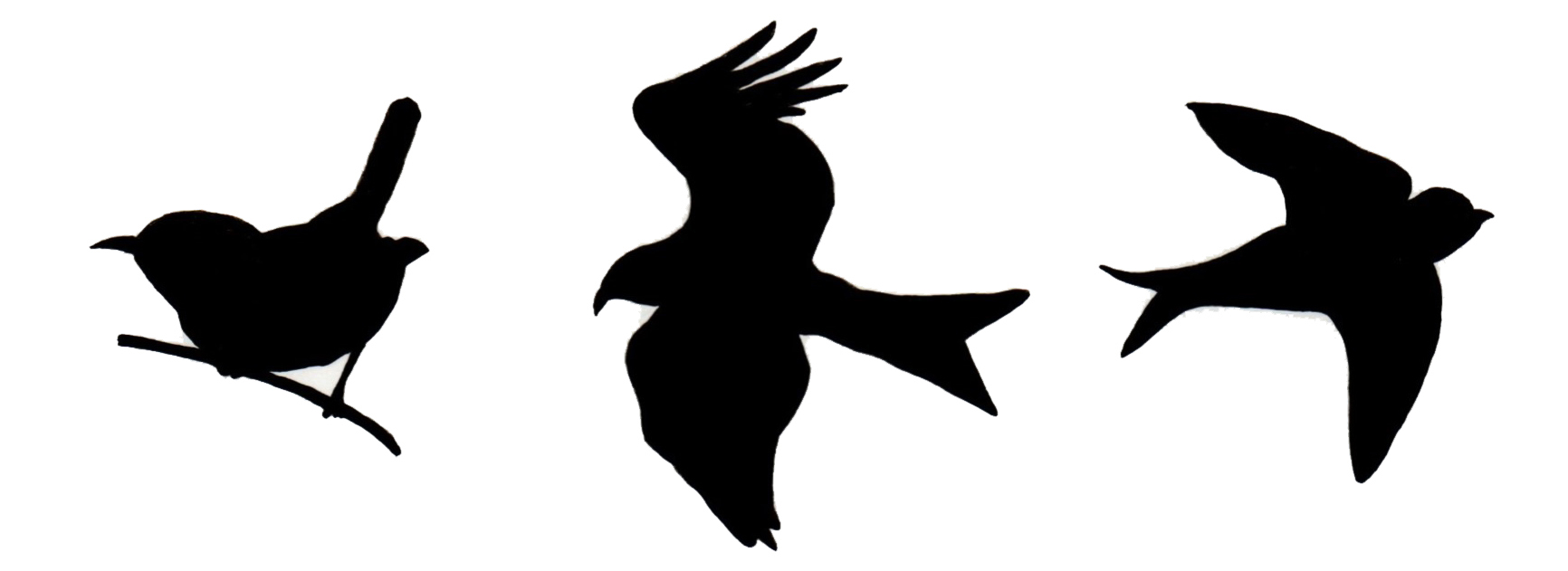
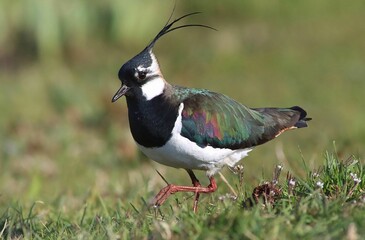
Come along to a talk about Swifts by Catharine Gale a trustee of Hampshire Swifts, a charity set up in 2016 to address the decline in Common Swifts in the county. In the first part of her talk she will tell us all about this iconic bird species covering its identification, how it differs from Swallows and Martins, feeding habits, migration, breeding behaviour, trends in population status in the UK, and potential reasons for its dramatic decline. In the rest of her talk she will describe what Hampshire Swifts has been doing to try to reverse Swifts’ decline, including some illustrations of the positive effect of providing swift nest boxes, and finishing with some recommendations for how we can all help Swifts.
All welcome, Froyle Wildlife members free, non-members £3, teas and coffees, doors open 7pm for talk to start 7.30pm, Friday 20th March at Froyle Village Hall.

Hampshire Swifts website says: These beautiful and charismatic birds have declined across Hampshire and the UK by approximately 65% over the past 25 years. They continue to decline at approximately 5% per annum. Hampshire Swifts was formed in 2016 in response to the on-going decline of this iconic bird across Hampshire. Our objective is to reverse the decline of Swifts in our county. This is best done by ensuring we provide an ever-increasing supply of suitable nest sites for our Swifts. We can achieve this by conserving existing nest sites and by providing nest sites on existing and new buildings.

HIWARG in Action: Safeguarding Local Amphibians and Reptiles 27th Feb 2026

Male and female adder soon after emerging from hibernation

Join us for a talk by Pete West about the volunteer conservation work carried out by the Hampshire and Isle of Wight Amphibian and Reptile Group (HIWARG) with a special focus on Froyle and surrounding areas. We will be looking at the eleven species known to be in the area (including at least two non-native species), the surveys we have carried out and key target species we are monitoring.
All welcome, Froyle Wildlife members free, non-members £3, teas and coffees, doors open 7pm for talk to start 7.30pm, Friday 27th February at Froyle Village Hall.

Great Crested Newt egg laying

HIWARG focuses on conservation of native UK species essentially around habitat management, surveying, public engagement, volunteer training and doing as much as possible to understand and protect the native species in the county. Pete West is the Amphibian Officer and has carried out surveys locally. In the last 15 years there have been a number of newly constructed ponds in Froyle with some in gardens and fields. Work has also started to restore an historic dew pond. These ponds help to increase local biodiversity and provide habitat for species such as amphibians and dragonflies.

Beaver and Water Vole Reintroduction talk, 25th Nov 2025

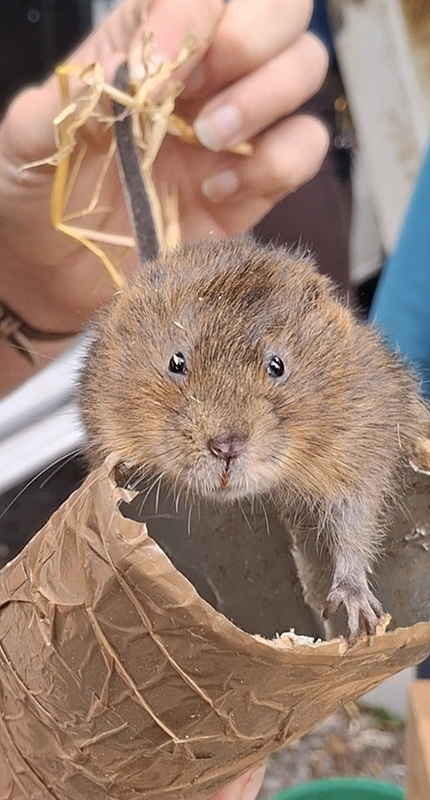
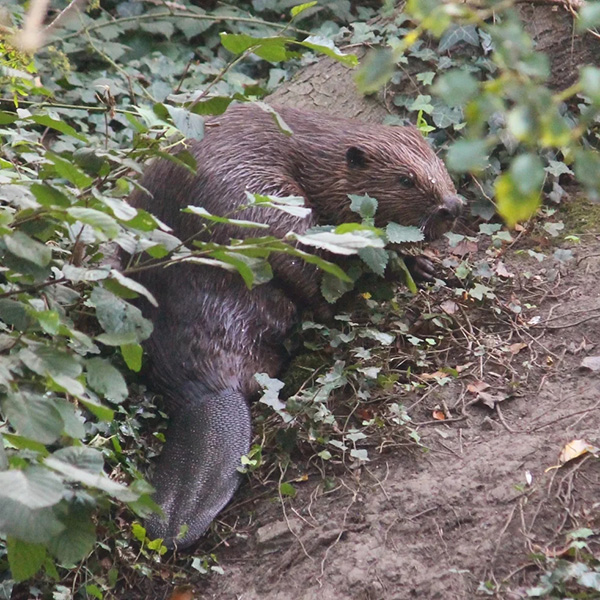
Come along to a talk about Beaver and Water Vole Reintroduction on Tuesday 25th November. David Elliott, the National Trust’s Lead Ranger for the South Downs West, will give a talk on beavers and water voles and their return to the landscape. He will give an update on the progress and work of the River Wey Water Vole Recovery project, and will also talk about where we are currently at with regard to the return of the Beaver, locally and nationally, as well as discussing their respective ecology and why they are such important species to consider when thinking about the future of our wonderful local rivers. He will be happy to take questions and participate in discussion.
All welcome, Froyle Wildlife members free, non-members £3, teas and coffees, doors open 7pm for talk to start 7.30pm at Froyle Village Hall.

Having once been an important part of the ecosystem, beavers became extinct in Britain in the 16th century because of hunting for their fur, meat and scent glands. This release follows a successful pilot at Holnicote on Exmoor in early 2020, where the beavers have thrived. In spring 2021 two beavers were released on the edge of the South Downs into a 15-hectare fenced area. A male and female were re-introduced, in the hope they will become a breeding pair. The exact location is not disclosed to give them very best chance of establishing themselves in their new home.

Some 150 water voles have been reintroduced into waterways in parts of southern England after being declared locally extinct over the last 20 years. They were released in August 2025 at six sites along the River Wey in Surrey, Sussex and Hampshire, and further reintroductions will take place over the next two years. The species is the country’s fastest-declining mammal because of habitat loss and predation by the non-native American mink. The population plummeted by 93 per cent in England during the course of the 20th century and has been in further rapid decline since 2000.

Summary of the talk

David Elliot set the scene by reminding us that wildlife in the UK is struggling, with insects reducing by a massive 60% over the last few years and one in six species are at risk of extinction.  The main two drivers for this are agricultural change and climate change.

A water vole’s lifespan is about 12 – 18 months, they have 4-5 litters a year and are vegetarian, eating reeds, grasses, rushes and sedges.  Female territories are roughly 20-30 metres wide with males overlapping several females.  Water vole numbers have been decimated over the last 50 years.  Unfortunately, water voles have a variety of predators, but the primary culprit for their disappearance is the North American Mink.

The River Wey Water Vole Recovery Programme is aiming to address the disastrous 90% decline in water voles in the River Wey catchment area (indeed a recent assessment considered the water vole extinct in the area).  The programme is following the approach of an initiative in East Anglia which has resulted in a very successful water vole reintroduction.  It is being achieved by the placement of 89 traps across the Wey network which have so far captured and removed 107 mink across the catchment.  It is soon expecting to have eradicated all mink from the River Wey.  So far, the programme has reintroduced 192 water voles in sibling groups across 6 sites between Haslemere and Liphook.  Monitoring will take place next year to assess how the water vole population is doing and to determine any further reintroductions.

Beavers have not been around in the UK for roughly 200 years because humans killed them.  They are a large riparian mammal with a vegetarian diet, the size of a labrador, and a lifespan typically of 8-9 years but can reach 11/12 years. They breed late Autumn/early Winter with young born in Spring.  Their predators include bears, wolves and (historically) humans.  Beavers are now coming back across Europe, with in the UK a small recent introduction in the South Downs area following a successful pilot introduction on Exmoor in 2020.

Beavers are well known for building dams in river headwaters creating wetland areas which provides a safe habitat for themselves.  However, this also provides a beneficial environment for other native wildlife species, while reducing flooding risk further downstream by effectively ‘storing’ water and reducing the water flow.  They are also earth movers and canal creators, again with beneficial flood risk effects.  Beavers fell trees providing a food source for themselves as well as building materials for their lodges and dams.  Fortunately, they fell only a few trees within each area, so they don’t create treeless landscapes.

Admittedly, depending on the location, beaver’s construction activities may not always desirable, but mitigation measures are available to us such as water pipe installations to address any issues such as controlling water levels when necessary.

Alan Dyos

Regenerative Farming talk and AGM 24th October 2025

Simon Porter will be explaining how Regenerative farming has the potential for the first time to produce the needed quantities of high-quality food to feed the world, whilst reducing inorganic sprays and fertilisers. At the same time, Regen farming can successfully store atmospheric carbon in the soil, improve wasteful water runoff and reduce harmful leaching of pesticides into our water supply. Regen farmers are also seeing a return in the numbers of beneficial insects and red-listed birds. Sounds too good to be true? Come and find out how it has been working successfully on a nearby farm for over 20 years. There will be time for your questions during the talk.
All welcome, Froyle Village Hall doors open 7pm, a brief Froyle Wildlife AGM starts at 7.30pm followed by the talk, entrance free for members, £3 non-members, teas and coffee.

School pond Froyle restoration 6th Sept 2025

Can you help to restore an historic pond in Froyle which has silted up on Saturday 6th September 10am to 1pm?
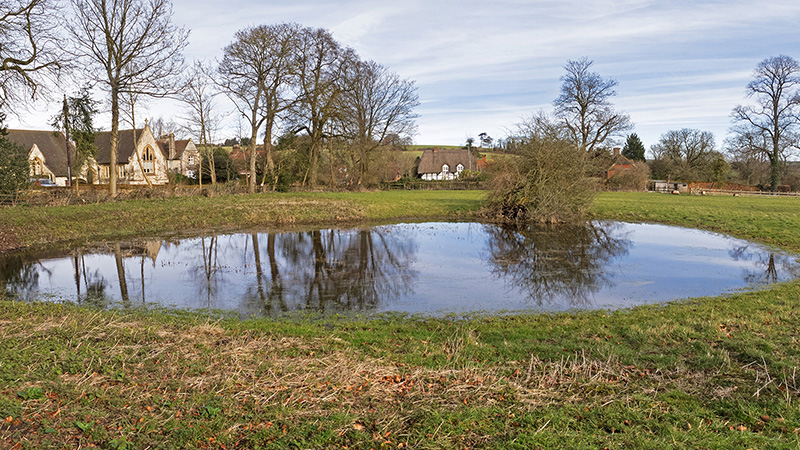
We plan to remove about a quarter of the vegetation and silt to benefit the known population of great crested newts as well as other protected species. Currently the pond dries out every summer before amphibians can complete their breeding life cycle. For example, in 2025 there was about 20cm depth of water on 11th April and by 4th May just damp ground. Pete West from HIWARG (Hampshire and Isle of Wight Amphibian and Retile Group) will be overseeing the work.
Recommend appropriate clothing, gloves and footwear for digging and moving silt. Please fetch a spade, fork or ideally a wheelbarrow if you can. School pond (also known locally as Dew pond) was shown on the 1845 tithe map of Froyle. The use of heavy machinery to dig out the silt is not a choice because of the historic habitat and any potential damage.
Please let me know if you can come along (even for just 1h) by contacting info@froylewildlife.co.uk.

Summary of the day.

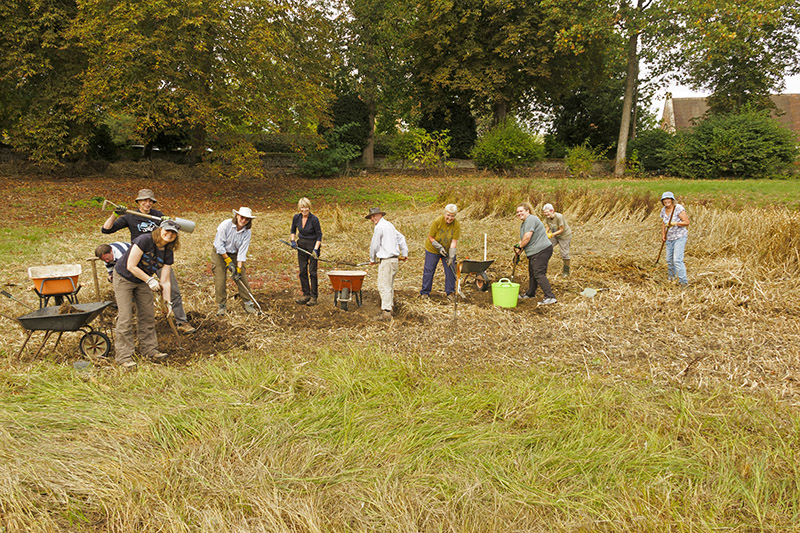
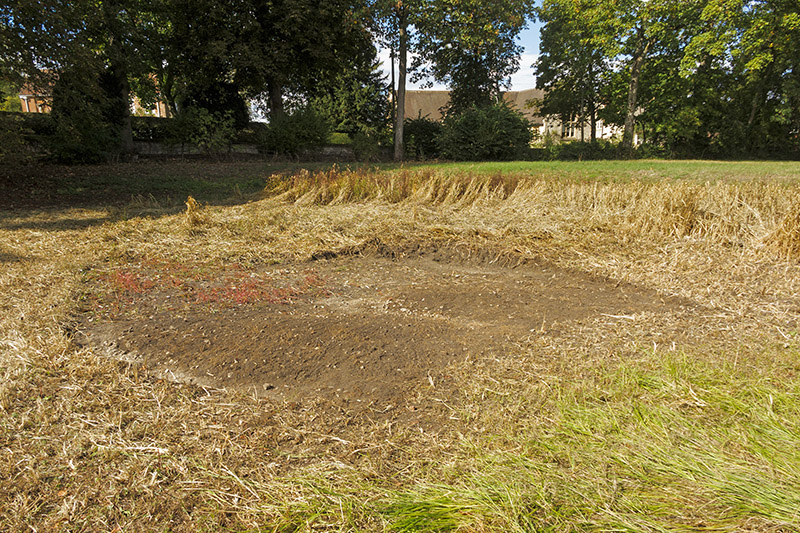
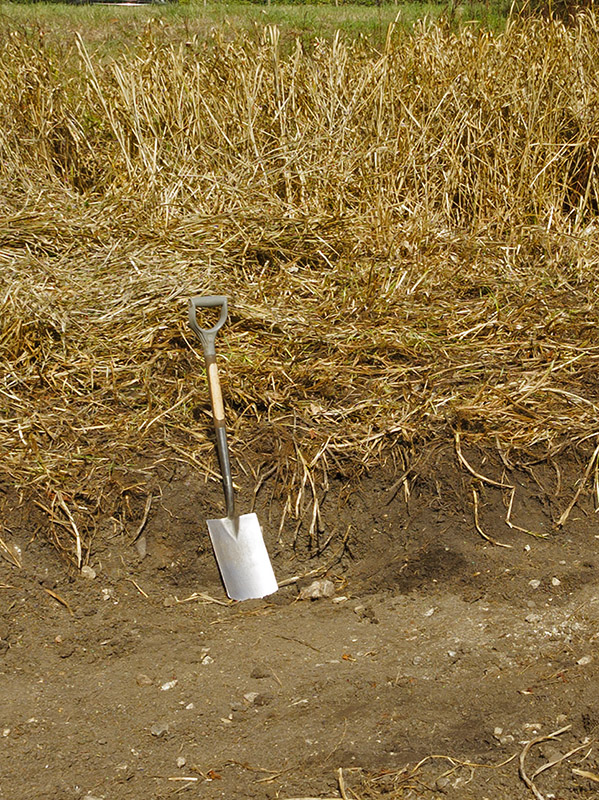
A group of volunteers made a good start to restore the Dew pond, digging out a quadrant. The silt was more difficult than anticipated to remove because of buried stones. The plan is to monitor the pond over next year to see if water is retained for longer. We could then repeat the digging on another quadrant.

We found buried metal including pieces of iron railing, rusted pipe as well as old broken bottle glass, a modern ring pull and a small rusted iron cleat. Sue from Upper Froyle, metal detected the spoil and found a copper coin. The coin was a worn George second half penny, the date was very difficult to read but is probably 1747. So nearly 280 years old!

Pond dipping Froyle 20th July 2025

Family fun –join us for a 1h dipping session on Sunday 20th July starting at 10am or 11.15am to see what underwater creatures we can find in the wildlife pond near Gid Lane, Upper Froyle. Children will need to be accompanied by a responsible adult. All equipment will be provided and numbers are limited so it is essential to book by emailing info@froylewildlife.co.uk, stating preference for 10am or 11.15am session.

A successful morning pond dipping

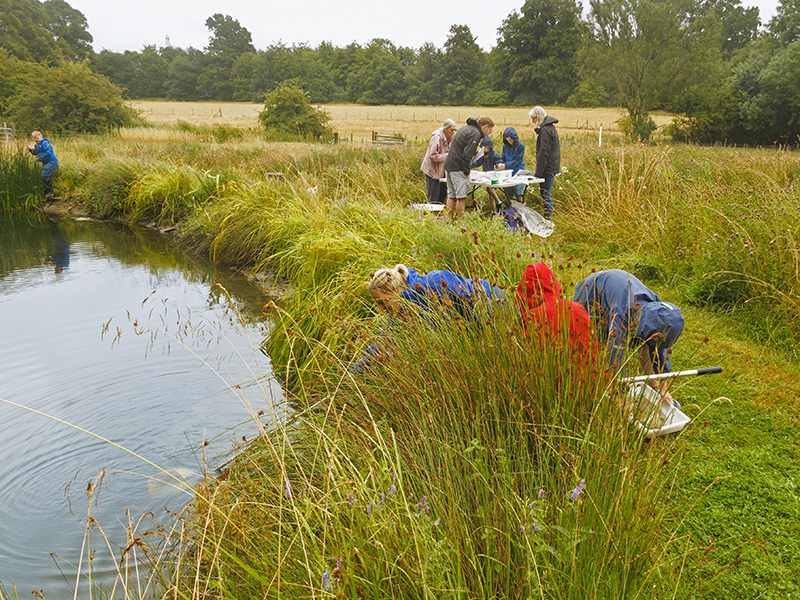
Several families enjoyed a lovely morning of pond dipping at the wildlife pond. Due to the lack of rain we were concerned that the pond level would have dropped too much for safe dipping so we had a smaller group this year. Despite this, we managed to collect a range of tiny creatures and examined them using our new portable wireless microscope. The microscope proved very popular with the children who quickly learnt how to use it to view water beetles, boatmen, dragonfly nymphs and young newts in greater detail. We created short videos, some of which are available to view on our Instagram site @froylewildlife.
Despite the lower water level of the pond, it was teeming with life and we enjoyed spotting dragonflies and damselflies too. The children and adults were amazed to see a ‘wasp spider’ with very long legs and vivid black and yellow stripes. Thank you to Barry Clark for bringing all of the equipment along and finding the wasp spider! We had a great time and hope to run our annual dip again next year.

Some photos taken on the day.


‘Drop-in’ day at Wildlife Pond 19th July 2025

Call in anytime between 10am and 4pm on Saturday 19th July to see what’s flying and flowering at the wildlife pond and meadow, near Gid Lane, Upper Froyle. There should be plenty to see especially if it’s a sunny day.

Members of Froyle Wildlife will be on hand to assist with identification of wildflowers, dragonflies and butterflies. Wildflower species to look out for include; knapweed, lady’s bedstraw, meadowsweet, self heal, purple loosestrife, water figwort and bird’s-foot trefoil. Ladybirds, hoverflies, bees and grasshoppers may also be seen. No need to book, anyone can just pop in and see what you can spot.

What did we see on the day?

After weeks of hot dry weather, we had drizzle on this July morning that deterred any visitors. It brightened in the afternoon for the dragonflies and butterflies to start fliting among the wonderful wildflower meadow that surrounds the pond. Butterflies counted were Gatekeeper 29, Meadow Brown 27, Large White 3, Green-veined White 3, Common Blue 4, Comma 2, Small Copper 1, Small White 1, Small Skipper 1. Odonata seen included Emperor dragonfly, Blue-tailed damselfly, Common darter, Small Red-eyed damselfly, along with bees, ladybirds and hoverflies. Among the vegetation was a metallic green Rose Chafer beetle, a wasp spider and a new species for the location a Turnip sawfly. The area is maintained by Froyle Wildlife volunteers and is definitely a hotspot for biodiversity in Froyle.

Walk at Abbotts Wood for woodland butterflies 8th July 2025

Join us for a walk on Tuesday 8th July, 10am-12 in Alice Holt forest for woodland butterflies. We should see Silver-washed Fritillary and may be fortunate to see the elusive Purple Emperor and White Admiral. Fetch binoculars for a better view of butterflies that are futher away. Meet at Abbotts Wood Inclosure car park GU10 4HA, off Dockenfield Street, just south-east of the former Halfway House pub. what3words landowner.likely.splendid.

How did our walk go?

A morning of warm sunshine was ideal for woodland butterflies in Alice Holt forest. We enjoyed seeing the variety and numbers of butterflies at Abbotts Wood along with close encounters while they were nectaring. The 17 species spotted are listed in the order that they were seen.
Silver Washed Fritillary (many), Meadow Brown, Red Admiral, Brimstone, Small White, Large White, Ringlet, Holly Blue, Comma, Large Skipper, Gatekeeper, Small/Essex Skipper, White Admiral, Peacock, Speckled Wood, Common Blue, Purple Hairstreak.
There were no positive sightings of Purple Emperor, although there were tempting flutterings occasionally high up in the trees.
We had not seen as many Silver Washed Fritillaries for a several years and it was lovely to see their courtship flights as well.

Walk at Noar Hill SSSI 25th June 2025

Join us for a walk on Wednesday 25th June 10am at Noar Hill SSSI near Selborne when we hope to see at least 4 species of wild orchid. This 20 hectare nature reserve, managed by Hampshire Wildlife Trust, was originally formed by medieval chalk workings. Over hundreds of years the mounds and hollows were colonised by a great variety of beautiful chalk downland flowers now rare in the wider countryside. Many species enjoy the micro climates amongst the undulations with over 30 butterfly species recorded.

Meet there 10am or preferably share lifts from Froyle Village Hall leaving at 9.30am. as there is very limited roadside parking, OS grid reference SU737321 near Charity Farm, what 3 words ///binders.flippers.measure .

Moth identification evening Froyle 17th May 2025

Find out what flies after dark? We plan to run a moth lamp on Saturday 17th May at the meadow surrounding the wildlife pond near Gid Lane. Come along anytime, starting 9pm until late, warm clothing and torch are useful. Also we will have a bat detector to hear the echolocation calls of any nearby bats.

There are nearly 2000 species of moth that occur in Hampshire. Moths and butterflies are useful indicator species for the health of our natural environment.

So what did we see? On a warm May evening we recorded 27 species including White Ermine, Nut-tree Tussock and Scorched Wing, see .pdf list. Most of the moths were photographed for conclusive identification of the species. These records where then submitted to the National Moth Recording Scheme via the Hampshire County Recorder

image_print