Organic farming, Walk at Mill Farm 8th Sept 2016

The Mill Farm walk and talk was on 8th September 2016 with thanks to Nick Shaylor for an inspirational evening.

Mill Farm cattleWe enjoyed a lovely late summers evening for our walk and talk at Mill Farm Organic, bordering Froyle and Isington. Owned by the Mayhew family, the farm extends to around 600 acres and has been managed organically for over 16 years, certified by the Soil Association. The main enterprises found on the farm are a herd of South Devon and Aberdeen Angus beef cows, a flock of Black Welsh Mountain and Easycare sheep and a herd of traditional breed pigs. These all produce meat which is sold at the farm shop  and at local Farmers Markets.

Mill Farm walk 2The farm covers a diverse range of habitats ranging from traditional water meadows bordering the River Wey to larger rotationally cropped fields and several pockets of ancient woodland. Managed with a close eye on conservation, many initiatives have been adopted to try and preserve and create important habitats for wildlife. Over the last sixteen years over 5 km of new hedgerows have been planted and many new native trees. Six metre grass field margins surround fields that are rotationally cropped. These are left completely undisturbed and provide a vital buffer between the rich hedgerow habitat and the more intensively managed farmland.

Mill Farm walk 1The farm has been gradually increasing the diversity of its pastures for several years. A species rich mixture of up to fifteen different varieties of grasses, legumes and herbs are now commonly sown. These mixed swards are much more resilient to drought conditions (due to the inclusion of many deep rooting species such as chicory and red clover). They also are great fertility builders, adding organic matter to the soil and helping to feed the soil food web – which is crucial as no chemical fertilisers or pesticides are allowed under the organic standards. When in flower these leys are a magnificent colourful sight and are rich in wildlife especially pollinators and butterflies. Newman Turner, who was a great advocate of herbal leys described them as his “fertiliser merchant, food manufacturer and vet all in one”.

The farm also benefits from a range of traditional farm buildings which have been left largely undeveloped. Several pairs of barn owls have been nesting in these this year.

Mill Farm walk 3A key focus of the farm is to offer as much diversity as possible. This is currently achieved in many ways, including the several different livestock enterprises present, the range of crops that are grown (and the season in which they are established), species rich grazing leys, hedgerows that are only cut every three years and pockets of land that are left completely undisturbed. The aim of the farm has and continues to be to develop and maintain a sustainable farming system, ensuring that plenty of room is left for nature.

To find out more about Mill Farm, please visit millfarmorganic.com and for more information about organic farming visit the Soil Association.


image_print

Wildlife pond Froyle, Sept 2016

Wildlife pond Aug16The new pond near Gid Lane was constructed in April 2016, by kind permission of Froyle Park Ltd. and funded by developer contributions through East Hampshire District Council. Although the area has looked rather bare this summer, advice from wildlife pond experts is to let the pond colonise naturally over time. So please do not introduce any fish or pond plants because this could bring in non-native species that are potentially invasive. The disturbed ground was sown in September with wildflower meadow mixtures for wet or chalky soils depending on the conditions. An area of tussocky grasses and wildflowers sown in April has grown well although we continue to weed out nettles, thistles and docks.

Emperor dragonfly egglaying Jul16Dragonflies have found the new habitat and three odanata species (Emperor Dragonfly, Common Blue Damselfly and Common Darter) were seen egglaying in the water. The marginal plants Blue Water-speedwell and Brooklime have naturally arrived to start growing. In July we saw two unidentified newts in the pond and then found a Great Crested Newt under a pile of stones. The wildflowers have attracted bees, hoverflies and butterflies. This increase in local biodiversity during the first few months demonstrates how we can help to give nature a home.

Hibernaculum Aug16As expected, the water level fell by about 50cm through the summer and rain in winter will then refill the pond. Thanks to the local volunteers who helped to cultivate the disturbed bare ground ready for seed sowing (link to seed list) and build a hibernaculum (pile of stones and wood topped with soil) as habitat for amphibians. A log pile is planned and the pond area can be seen from the public footpath along the Lime Avenue.

image_print

Walk at Mill Farm Organic, 8th Sep 2016

Mill Farm cattleJoin us for a guided farm walk at Mill Farm Organic, Isington, GU34 4PN on Thursday 8th September. Lead by Nick and Jenny Shaylor, meet at the Farm Shop at 6pm and finishing about 8pm. Outdoor clothing and sturdy footwear recommended.

Learn about what we do on this mixed organic farm and how we produce great quality, fully traceable meat locally in Isington under a low input, forage based organic farming system. The farm spans a wide range of habitats and has a strong focus on sustainability and nature conservation, which will be a key focus of the evening. It would be useful to email walksandtalks@www.froylewildlife.co.uk to let us know numbers or you are all welcome to just turn up on the evening.

image_print

The ‘Magic of Bees’ a talk and walk 23rd July 2016

Find out why bees are important and how to identify some of the commonly seen solitary and bumblebees.

On the 23rd July come along and hear about “The Magic of Bees” followed by a walk to see what’s buzzing in Froyle. – Meet at the Village Hall at 10am. We will be visiting the rec and nearby gardens. Please check this website page if weather conditions look uncertain. We are fortunate – our walk leader, Mike Edwards, co-authored the ‘Field Guide to Bumblebees of Great Britain and Ireland’!

Woolcarder Bee
Woolcarder Bee
Bombus lucorum m
Bombus lucorum m
Bombus hypnorum queen
image_print

Enjoying the Wildlife of Froyle, June 2016

Enjoying the Wildlife of Froyle

We have lived in Froyle now for nearly 12 years, relatively new residents compared to many, but every day I am appreciative of how lucky we are to live here, with the countryside and wildlife on our doorstep. This was highlighted on a recent two mile dog walk around Lower Froyle.
House MartinIt was a gloriously sunny morning. We left our resident house martins behind in the nests around our house. After their long journey back from Africa we are hoping they will be successfully breeding, to help keep up, and perhaps swell, their ‘amber listed’ population. Shortly afterwards we encountered a Red Kite, another ‘amber listed’ bird, magnificently gliding low over the houses and gardens. ‘Amber list’ includes species where there is falling populations or contracting ranges.
Log seat FroyleWhilst walking close to the quarry, Skylarks were in songflight, some so high in the air that they were barely visible. This is a relatively common occurrence here, but not typical generally for the UK now as Skylarks are on the ‘red list’ of endangered or vulnerable species. In the hedgerow we heard the ‘little bit of bread and no cheese’ song of a Yellow Hammer, another species on the red list.

A Roe deer doe was standing in the shade of a tree at the edge of a field behind long grass. Luckily the wind must have been in its favour as the dogs were unaware of it. It remained there just watching us, perhaps it had a kid nearby.
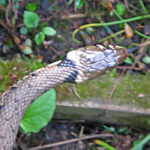
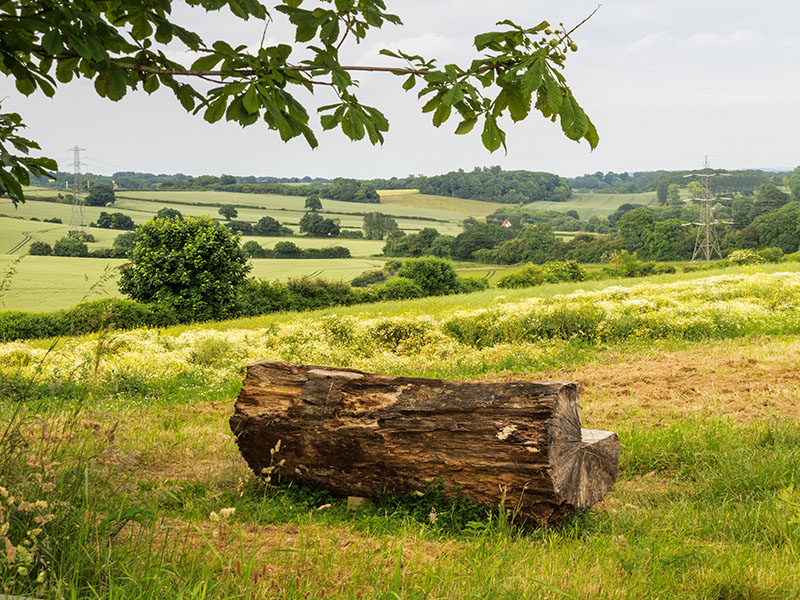
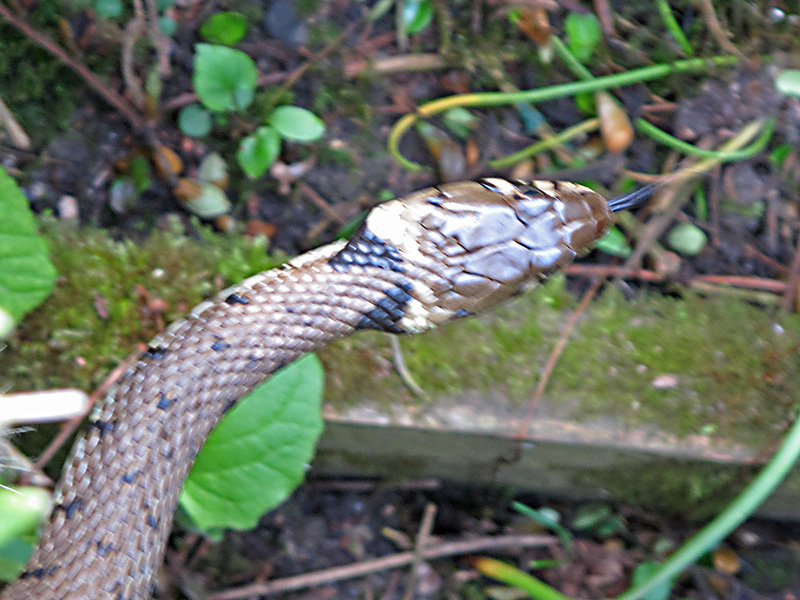
Grass snakeAs usual we stopped to admire the view from the thoughtfully placed ‘tree bench’ at the top of Hussey’s Lane. On returning down the lane, a Grass Snake slithered back into the vegetation at the edge of the track, having been disturbed from basking in the sun by our footsteps. A Blackcap sang its melodic song further down the track.
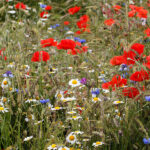
Sown wildflowers Froyle recComing across the Recreation Field, we admired the blooms of the ‘Wildflower area’. Once back in our garden, the hedgehog droppings were evidence of a visitor or two the night before, presumably consuming the food that we put out for them each evening.

Whilst I appreciate this is by no means an exhaustive list of Froyle wildlife, I feel very fortunate to be able to experience the sorts of encounters mentioned above.

Jayne Fisher

image_print

Dragonfly Walk Sat 18th June 2016

DRAGONFLY WALK – SAT JUNE 18th  – Walk Leader Dr Bill Wain.          

If you would like to join this walk please email walksandtalks@www.froylewildlife.co.uk. This helps us to have an idea of numbers and to wait for anyone who may be delayed. However, if you are a last minute decision-maker, please just turn up on the day! We hope to see several species and pick up some tips on identification (see British Dragonfly Society) after our talk in March.

Meet at Froyle Village Hall at 10am. Our first site is within walking distance of the hall but transport will be provided if necessary. The second site, most likely along the River Wey, will require walking boots. Binoculars are handy for a closer view and here is the link to species seen last summer in Froyle. Hope to see you there.

Update: Some photos of sightings on our walk.

Wildlife pond Froyle
Emperor Dragonfly exuvia
Common Blue damselfly
Emerging dragonfly
Emerging dragonfly
Azur damselfly
Azur damselfly
Finding a froglet
Finding a froglet

At a pond in Lower Froyle, Bill Wain spotted over 20 exuvia (empty skins) of Emperor Dragonfly that had recently emerged. A Common Blue Damselfly allowed close views while stationary and an emerging dragonfly on the flag iris leaves was probably a Four-spot Chaser. The absence of any sunshine meant that none were flying.

image_print

Bluebell Walks 2016 Summary

BLUEBELL WALKS IN APRIL 2016- FROYLE ESTATE

Thanks to the invitation from Froyle Estate, 30 Froyle residents were able to enjoy walks in Hawkins Wood to see the carpets of bluebells, amongst other plants, on two occasions in April this year. Thanks also to Sue C who led the walks with great enthusiasm and knowledge.

1771 Froyle woodlands12lHawkins Wood is semi-natural ancient woodland which is thought to be at least 400 years old. This is borne out by looking at the 1771 survey of Froyle woodlands. The area shown here is the same area of woodland as depicted in current maps.
Woodland has been essential for the daily life of folk for the majority of its existence, enabling bowls, cutlery, buildings and furniture to be made, and of course providing vital firewood. Coppicing was regularly carried out to provide wood; this in turn opened up the forest floor to light, allowing ground flora to establish. Hawkins Wood is a SINC, (Site of Importance for Nature Conservation) and as a habitat is irreplaceable. Plants can be used as indicators for ancient woodland.

Froyle bluebells 3The Bluebell has been voted as top of England’s favourite wildflowers. In the past the bluebell sap was used to fix feathers on to arrows, and as a starch for Tudor ruffs. Globally wild bluebells are scarce and the UK has 40-50% of the World’s population. Unfortunately, the non-native Spanish bluebell is in danger of pushing out our native bluebell, through crossbreeding with it.

As well as the glorious bluebells, other ancient woodland plant indicators that were seen on the walk included Yellow Archangel, Wood Anemone, Barren Strawberry, Early Dog-violet, Primrose, Wood Sorrel, the imaginatively named Townhall Clock with delicate flowers facing in 4 directions, and Toothwort, again appropriately named for its tooth like appearance, a plant that is parasitic on tree roots.

Froyle bluebells 2Amongst the trees it was interesting to see a coppiced beech tree, measuring 7.6m in girth, thought to be at least 300 years old. The coppiced wood may well have been used by bodgers to make chair legs in years gone by.

Jayne F.

image_print

Swift Talk 2016 Summary – Nest site creation in Froyle?

Swift talk FroyleEdward Mayer delighted over 50 people with his enthusiastic and inspirational talk on swifts (and a little on swallows). As well as bringing that uplifting sound of summer, these amazing birds are superbly skilful flyers and they drink, feed and even mate in flight!

Across the UK It is estimated 11,000 new nests sites need to be created just to halt the decline of this amazing bird. We don’t make things easy for them – Swifts mate for life and are faithful to each other. They seek to return to the same nest site year after year. Renovations such as loft insulation and re-roofing, and conversions or demolitions can mean swifts fly 14,000 miles back to the UK only to find their nest sites are no longer there or cannot be accessed. Swift in flightModern architectural and home ‘greening’ practices are also making it harder for swifts to replace the sites that are lost and for young swifts to find their first home.

Despite the issues, Edward’s uplifting message was how easy it is for people to incorporate, replace or create new nest sites. In Froyle we have the perfect opportunity to help our local populations to survive and thrive so that swifts remain a beautiful sight and sound for us to enjoy every summer.
Swift bricks & nest boxes are relatively inexpensive and can be fitted to new builds and during any renovation work to roofs, soffits and guttering. Imagine the positive contribution to swifts if every home in Froyle had just one swift brick or nest box!

The swift conservation website has details of nest-boxes and bricks. The lowest cost option is a self-assembly plywood nest-box for use under eaves or on walls. The two models plus a sound recording to help attract swifts can be purchased for £15 / £17 plus postage. Built-in swift bricks start at £25. (http://www.swift-conservation.org/Shopping!.htm).

If you would like to support our local populations of swifts and want to learn more, we have a local group “Hampshire Swifts”. They can be contacted via Andy Broadhurst (andy@tali.me.uk). The group has a website (www.hampshireswifts.co.uk) and a Facebook group (www.facebook.com/groups/HampshireSwifts) .

The ‘Hampshire Swifts ‘website link takes you to the swift survey page. Please record any 2016 sightings you make so that Hampshire’s swift records are up to date and accurate.

Finally, if you think a village-wide initiative to create new nest sites is a good idea please let us know!

image_print

Swifts “Keeping the Skies Alive” 12th May 2016

If you love the sight and sound of swifts in high summer then this is the talk for you.

Swift in flightThis amazing acrobatic bird drinks, preens, collects food and nesting material, and even mates on the wing! We are very fortunate to see their evening acrobatics and hear their characteristic screaming in Froyle as swifts have declined nationally by almost half over the past decade. Their preference to repair and reuse the same nests which are often lost during building and renovation work, coupled with a steep decline in their food supply (flying insects and airborne spiders), makes life challenging for them. The RSPB reports that within 20 years swifts will become rare in the UK unless action is taken to help them.

Our speaker, Edward Mayer, has loved Swifts since childhood. He has set up ‘Swift Conservation‘, a web-based advice service celebrating swifts. He provides advice to government, building professionals and the public.  Edward will talk about the challenges facing swifts. He will also cover cost-effective and simple solutions to protect and encourage swifts (and similar looking summer migrants like swallows and house martins) when we renovate, build or rebuild. This will include how to create and maintain the habitats that encourage population growth of their food sources.

Edward has been highly recommended to us as an excellent speaker and presenter.

PLEASE NOTE THE TALK WILL START AT 7pm, doors open from 6:30pm.
Entrance fee £2, refreshments available.
Donations welcome for Swift Conservation & Froyle Nature Conservation.
Raffle.


image_print

New pond near Gid Lane, April 2016

Start of pond excavations

Good news! Work started on the new pond near Gid Lane in April with permission from Froyle Park Ltd. The contractor digging the pond is expected take 3-6 weeks and excavations can be seen from the footpath along the Lime Avenue. The project is funded by developer contributions through East Hampshire District Council. Once completed, our advice from wildlife pond experts is to let the pond colonise naturally over time, so please do not introduce any fish or pond plants.

Our planning application ref 56422/001 for the pond was approved by EHDC in February 2016 and here is a link for more information:- supporting statement, site location plan and pond plan. The bare soil exposed by the ground works will be sown with tussocky grass and wildflower meadow seed. This is dependant on soil conditions and seasonal timing. After the works are finished and the ground prepared for wildflower seed sowing there will be permitted access for members of ‘Froyle Wildlife’, a group that anyone can join.

Progress updates: Photo of levelling the pond perimeter, view from the Lime Avenue and the filled pond.

Levelling the perimeterFroyle Pond 3Froyle Pond 4

image_print