Join us for a walk on Tuesday 8th July, 10am-12 in Alice Holt forest for woodland butterflies. We should see Silver-washed Fritillary and may be fortunate to see the elusive Purple Emperor and White Admiral. Fetch binoculars for a better view of butterflies that are futher away. Meet at Abbotts Wood Inclosure car park GU10 4HA, off Dockenfield Street, just south-east of the former Halfway House pub. what3words landowner.likely.splendid.
How did our walk go?
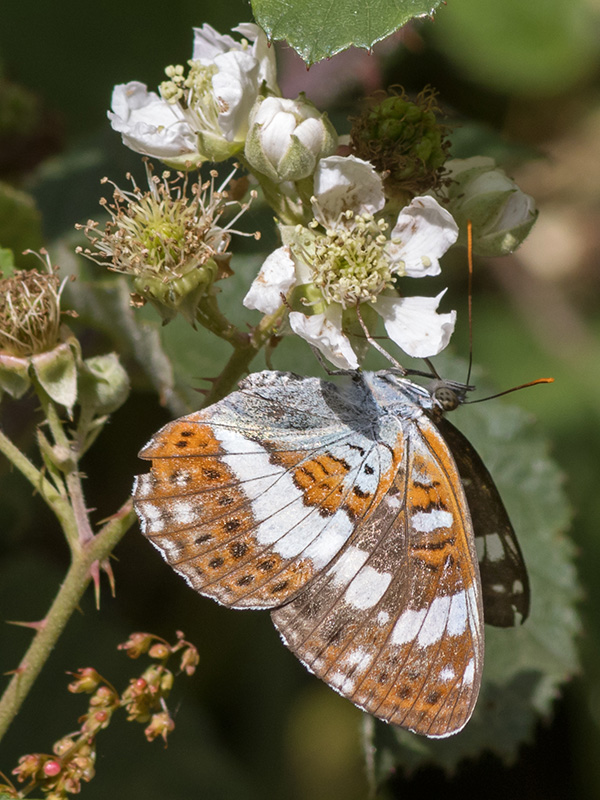
A morning of warm sunshine was ideal for woodland butterflies in Alice Holt forest. We enjoyed seeing the variety and numbers of butterflies at Abbotts Wood along with close encounters while they were nectaring. The 17 species spotted are listed in the order that they were seen.
Silver Washed Fritillary (many), Meadow Brown, Red Admiral, Brimstone, Small White, Large White, Ringlet, Holly Blue, Comma, Large Skipper, Gatekeeper, Small/Essex Skipper, White Admiral, Peacock, Speckled Wood, Common Blue, Purple Hairstreak.
There were no positive sightings of Purple Emperor, although there were tempting flutterings occasionally high up in the trees.
We had not seen as many Silver Washed Fritillaries for a several years and it was lovely to see their courtship flights as well.
Join us for a walk on Wednesday 25th June 10am at Noar Hill SSSI near Selborne when we hope to see at least 4 species of wild orchid. This 20 hectare nature reserve, managed by Hampshire Wildlife Trust, was originally formed by medieval chalk workings. Over hundreds of years the mounds and hollows were colonised by a great variety of beautiful chalk downland flowers now rare in the wider countryside. Many species enjoy the micro climates amongst the undulations with over 30 butterfly species recorded.
Meet there 10am or preferably share lifts from Froyle Village Hall leaving at 9.30am. as there is very limited roadside parking, OS grid reference SU737321 near Charity Farm, what 3 words ///binders.flippers.measure .
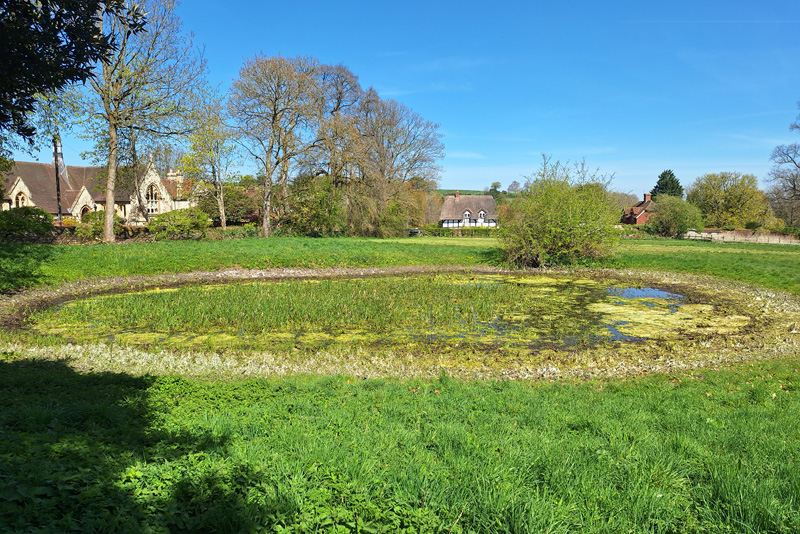
Find out what flies after dark? We plan to run a moth lamp on Saturday 17th May at the meadow surrounding the wildlife pond near Gid Lane. Come along anytime, starting 9pm until late, warm clothing and torch are useful. Also we will have a bat detector to hear the echolocation calls of any nearby bats.
There are nearly 2000 species of moth that occur in Hampshire. Moths and butterflies are useful indicator species for the health of our natural environment.
So what did we see? On a warm May evening we recorded 27 species including White Ermine, Nut-tree Tussock and Scorched Wing, see .pdf list. Most of the moths were photographed for conclusive identification of the species. These records where then submitted to the National Moth Recording Scheme via the Hampshire County Recorder
In essence moths are fantastic pollinators, they are a part of nature’s food chain, and they are an early warning indicator for problems in the wider environment.
Moths bring a rich biodiversity with around 2,000 species in Hampshire, and they come in all shapes, sizes, and colours. They are an important element of the food chain, being prey for a wide range of birds, bats and other insectivorous animals. For example, it takes around 15,000 caterpillars to feed one nest of Blue Tit chicks though to fledging. Recent research shows that moths are more efficient pollinators at night than bees are during the day. Although most moths fly after dark but there are also some that fly during in daylight, such as the Silver Y, Cinnabar and Scarlet Tiger. Surprisingly, there are more day flying moth species in the UK than there are butterflies. Look out for the amazing Hummingbird Hawkmoth that migrates thousands of miles from the Mediterranean to get to the UK in summer.
Moths are indicators of the wider natural environment and when their numbers drop our ecosystem is in trouble. Do you remember that decades ago, if you drove the car at night the windscreen would be plastered with insects -but not today. This decline in numbers is mainly due to climate change, habitat loss and intensive agriculture. You can help to protect our moths by planting wild flowers, growing patches of scrub and rough grass, and turning off lights at night.
For more information see Butterfly Conservation’s website https://butterfly-conservation.org/moths-matter.
Froyle Moth Recording We recently held two moth identification evenings after dark in Froyle during May 2025. One was held in a Lower Froyle garden and recorded 25 species including Poplar Hawk-moth, Iron Prominent and Brimstone moth. The second was held in the wildflower meadow that surrounds the pond near Gid Lane and recorded 27 species including White Ermine, Nut-tree Tussock and Scorched Wing, see .pdf list. These records are submitted to the National Moth Recording Scheme via the Hampshire County Recorder.
There are some peculiar moth names, for example Rosy Footman, Old Lady, Heart & Dart, Flame Shoulder, Chinese Character and Mother Shipton. All of these have been recorded previously in Froyle with a total of nearly 300 species.
All welcome to a talk on Thursday 20th March about ‘Understanding Birds and how they live’ by Keith Betton. As a regular visitor to Froyle, Keith’s talks are always entertaining and informative, so come along and find out everything you wanted to know about birds but were afraid to ask.
Froyle Village Hall, doors open 7pm for talk to start at 7.30pm, teas and coffee.
Keith Betton is a media trainer, PR consultant, writer and occasional broadcaster. He is a keen world birder having seen nearly 9000 species in over 100 countries, so he is one of the world’s top 40 birders of all time. He is heavily involved in bird monitoring in Hampshire, where he is Chair of the Hampshire Ornithological Society. He has been a Council Member of both the RSPB and BTO, and Vice President of the latter. His two books (with Mark Avery) “Behind the Binoculars” and “Behind More Binoculars” have been highly rated, as has his revision of “Where to Watch Birds in Dorset, Hampshire and the Isle of Wight”. He is particularly active in protecting Peregrines and Stone Curlews, and that has put him on BBC TV’s Springwatch.
Summary of talk: We enjoyed an informative and entertaining evening with Keith’s illustrated talk. To begin with we heard that 382 bird species were observed in Hampshire in 2024, of which 110 are resident, the remainder being summer or winter visitors, passing through or rarities (169 species) – birds which are here because they have got lost or been blown off course while going somewhere else. In the UK as a whole there are 220 breeding species and 100 winter or passage visitors, so Hampshire offers a disproportionately large number, probably because it is by the sea and on some of the migrant routes. Although eight species are now extinct in the UK and seven more are in decline, more than 13 have arrived here, including, as we see in Froyle, over 500 pairs of red kites. Birds have been on earth for about 150 million years whereas humans only about 1 million – and most of the decline in the bird population is attributable to human activity, in particular industrialisation and climate change, which has changed the temperature in birds’ habitats, altered their food supplies and caused habitat loss.
In the second half Keith discussed migration – “the return seasonal movement between regular breeding and non-breeding areas”. About 2,000 bird species migrate, principally in search of food and also to avoid extreme cold, so to maximise their chances of survival. They navigate by the sun and the stars, the earth’s magnetic field and, over oceans, by smell. Migration is generally governed by day length, rather than temperature or other factors, which has implications for survival if food availability changes eg as a result of climate change. Almost all migration is on a north/south axis – apart from the North American wheatear which spends its summers in Alaska and winters in Africa. Keith highlighted the arctic tern, the bird which has the most daylight in the year as it moves between the Arctic and Antarctica; and the bar-tailed godwit, flying 11,700 km in 8 days non-stop from Alaska to New Zealand (it makes a longer return trip, stopping in China). Space does not permit a fuller account of his talk, which was full of fascinating facts and much enjoyed by the audience. To find out more, join HOS!
Jonathan P.
Be inspired by some stunning wildlife images of the UK natural world – mammals, birds, insects and landscapes – taken by Jon Hawkins, on Friday 7th February 2025 at 7.30pm in Froyle Village Hall.
As a professional photographer, wildlife is his hobby. The talk will describe how he achieved getting the photos in relation to the subject. Understanding wildlife is a key essential to taking pictures in the natural environment. Jon’s pictures and associated talk will be a reflection of his appreciation for his subjects and surroundings. Although he shows some settings he used on the photos, there is only brief mention about the technical aspects of photography.
Jon Hawkins is an award winning photographer based in Ash Surrey, see https://surreyhillsphotography.smugmug.com/Galleries/Wildlife. His images have been published in various national magazines, newspapers, greeting cards, calendars and websites including use by the BBC, Sky and National Geographic. Before turning professional as ‘Surrey Hills Photography’ one of his images was included in the BBC’s Countryfile Calendar.
All welcome, Froyle Village Hall, doors open 7pm for talk to start at 7.30pm, teas and coffee.
Join us for a talk entitled the ‘Wildflowers of Froyle’ by botanist Isobel Girvan on Thursday 21st November. How much has changed in the last 30 years to the native flora that grow locally. Isobel has lead plant identification walks in Upper and Lower Froyle in recent years.
White Helleborine
This joint project with Alton Natural History Society recording plant species in Froyle is an update to a previous survey in 1991. The variety of locations surveyed included roadside verges, field and wood edges alongside public rights of way as well as other areas with landowner’s permission.
All welcome, Froyle Village Hall doors open 7pm, a brief Froyle Wildlife AGM starts at 7.30pm followed by the talk, entrance free for members, £3 non-members, teas and coffee.
Text from Surrey Wildlife Trust website about Isobel is copied below:- Principal Ecologist, specialising in bespoke botanical surveys and habitat management plans, as well as undertaking National Vegetation Classification (NVC) surveys and has superb knowledge of the UK Habitat Classification system. She has been a full member of the Chartered Institute of Ecology and Environmental Management (MCIEEM) since 2003 and is a Fellow of the Linnean Society (FLS).
She is on the committee for Surrey Botanical Society, Hampshire Flora Group and Alton Natural History Society, attending many of the field meetings during the summer. In the winter there are always mosses to identify with the British Bryological Society.
If there was one thing she would like to see everyone do to help biodiversity it would be to leave at least a small corner of the garden for nature with some decaying wood, or a window box with native wildflowers.
Summary after the talk
Isobel Girvan gave a fascinating talk on the Wildflowers of Froyle, updating a survey originally carried out in 1952 and done again in 1991.
Over the 72 year period the number of species recorded has increased from 86 (1952, which excluded grasses) to 370 (1991) and 429 in 2021/2022. All three surveys have identified a total of 695 species – “a good number”, reflecting the rich biodiversity of our local area. Isobel and her helpers made 25 different visits covering 18 out of the 32 “monads” (a square, 1km x 1km) which make up the area of Froyle, collecting over 2,300 plant records. They visited private land, with permission, and walked public paths and bridleways – but no gardens. Generally they surveyed when the weather was decent – woodlands in April/May, grasslands in June/July, and again in August and the autumn. They recorded 121 plants only once, and only one plant on every visit. What was it? Scroll to the end.
Two particular highlights were the white helleborine, a rare orchid which grows under beech trees, and toothwort or corpse flower, which is hemi-parasitic on hazel and an ancient woodland indicator. 121 plants were only recorded once, and one plant was recorded on every visit. What was it? See the end of this article.
All three of the surveys identified seven broad habitats in the area: woodland (23%) predominates, then neutral grassland (18%), chalk grassland 16%, wetland, garden/urban, arable and other. In four of the woodland areas they found 42 ancient woodland indicators (“ancient woodland” is woodland which has been managed as such continuously for at least 400 years), including wych elm, bluebells, greater stitchwort, red campion, bugle and dog’s mercury. We are fortunate in Froyle to have as much ancient woodland as we do, and in particular to have so many wild bluebells, which although common are protected as they are in decline.
Bee Orchid
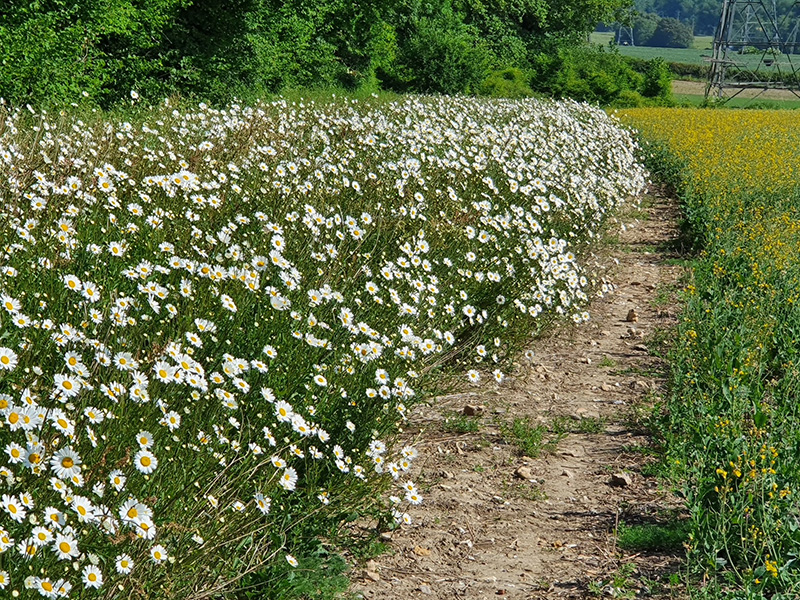
On our chalk grasslands Isobel found many species, including bee orchid, pyramidal orchid, common broomrape and quaking grass, and on the neutral grassland, creeping buttercup, meadow buttercup, cowslips and ox-eye daisies. Even in the arable and hedgerow habitat there was a rich variety of plants, from teasels to musk mallow and dog rose, as there was also in the walls and banks.
About 100 species were recorded for the first time, including red valerian (probably a garden escape), slender rush (an import from the USA first recorded in Hampshire in 1910 and now naturalised here, can be found on path edges) and wall rabbit. And there at least 225 to be recorded in Froyle, such as wild thyme, gorse and corn spurry, so there is scope for more work surveying.
The number and range of wild plants in Froyle is an indicator of the rich biodiversity we enjoy and benefit from, and need to foster: if we want to do one thing to help with that Isobel encouraged us “to leave at least a small corner of the garden to nature”.
Come along to a talk about ‘Why We Need Trees’ by Ben Hamlin, starts at 7.30pm on Friday 11th October in Froyle Village Hall. All welcome to this joint meeting with Froyle Gardening Club.
Lead volunteer with the Woodland Trust, Ben is a retired teacher who had a Damascene moment whilst walking in Alice Holt, since when he has taken every opportunity to tell people about the importance of trees to us. He combined being Tree Warden for Binsted and volunteering for the Woodland Trust with being Mayor of Alton. With a Q&A session at the end of the talk.
Summary after the talk:-
This was both informative and sobering in equal measure. Ben is a lead volunteer with the Woodland Trust with specific responsibility as a tree health surveyor in our area.
The talk covered topics including ‘why we need trees’ (for our health and wellbeing, for wildlife habitats, to clean our air and to help prevent soil erosion are some) and ‘what is the problem?’ (only 13% of the UK has tree cover, only 2% of Britain is ancient woodland with only 15% of that being protected, and a half of our ancient woodland has been lost or damaged since the 1930’s).
Ben then emphasised the threats to trees and woods. It may come as little surprise that climate change is a big factor, and that humans are also responsible for the intensive agriculture and infrastructure/development which all contribute to our declining trees. As a result, ecosystems have disappeared including thousands of miles of hedgerows, and associated wildlife has declined including 55% of woodland butterflies that depend on trees for their lifecycle.
The Woodland Trust owns and cares for a thousand woods in the UK. Their mission covers the creation, protection and restoration of trees and woods. For example, they have planted 43 million trees in the last 45 years. Their current aim is to create 2000 hectares of new native woodland. To add to the 0.5 million people already supporting the Woodland Trust, visit their website www.woodlandtrust.org.uk where you can locate the nearest woods to visit, become a trust member and identify opportunities to volunteer with the trust.
The wildflower areas on Froyle recreation ground provide nectar for bees and other pollinators as well as a colourful display for the community. The perennial area had its annual cut at the end of July after flowering well. Volunteers used traditional scything and then removed the cuttings. The Spring sown cornfield annuals then had a colourful display through July and August.
We plan to change the cornfield annuals area to perennials by cultivating the ground this September and then sowing perennial seeds. A mixture of British native species that are different to the original wildflower area are planned thus increasing diversity and flowering times. If you like seeing wildflowers on Froyle rec then do come along to help, for more information contact us.
Here is a list of the planned perennials from seed Agrimonia eupatoria (Agrimony) ; Betonica officinalis (Betony) ; Galium verum (Lady’s Bedstraw) ; Geranium pratense (Meadow Crane’s-bill) ; Knautia arvensis (Field Scabious) ; Leontodon hispidus (Rough Hawkbit) ; Malva moschata (Musk Mallow) ; Onobrychis viciifolia (Sainfoin) ; Poterium sanguisorba ssp sanguisorba (Salad Burnet) ; Prunella vulgaris (Selfheal) ; Ranunculus bulbosus (Bulbous Buttercup) ; Rumex acetosella (Sheep’s Sorrel) ; Red Campion; Wild Carrot; EG6 – Meadow grass mixture ; and from plants -cowslips, marjoram. Please let me know if you have any other favourite British native species that flower in late summer or if you want to grow a few seeds yourself to provide back-up plants in 2025.
Visiting the wildflower meadow that surrounds the pond area in July 2024, we spotted an insect that I had never seen before. It stayed long enough to get several photos for identification. It had yellow and black stripes so was it a bee, wasp or hoverfly? No, it was a sawfly with the name Tenthredo schaefferi classed as a vulnerable species. I was unsure of the identification so sought the help of an expert Andrew Green who is the sawfly recorder for the UK, see https://www.sawflies.org.uk/. The photos were sufficient to tell it was a female sawfly, one of four similar species: arcuata, brevicornis, notha, schaefferi. The species schaefferi is the rarest and the larvae feed either on Tufted Vetch or Field Scabious both of which grow in Froyle Wildlife’s meadow.
The National Biodiversity Network collate species records across the UK and there is only one record in Hampshire (near Southampton) for this sawfly. So why is one small insect significant? Indicators of habitat and biodiversity!
The food plants of this sawfly were once common in the wider countryside but now tufted vetch and field scabious are scarce in our field edges and hedgerow bottoms.