Biodiversity gains at Froyle recreation ground March 2026

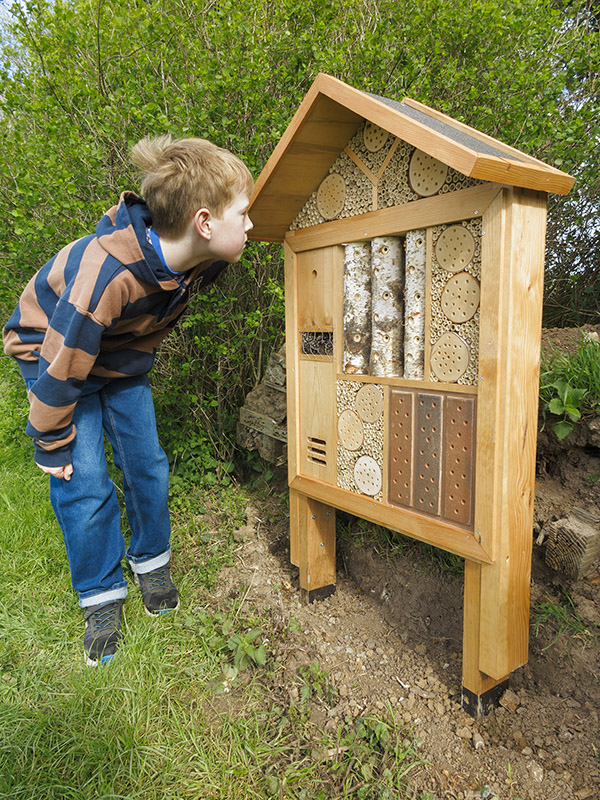
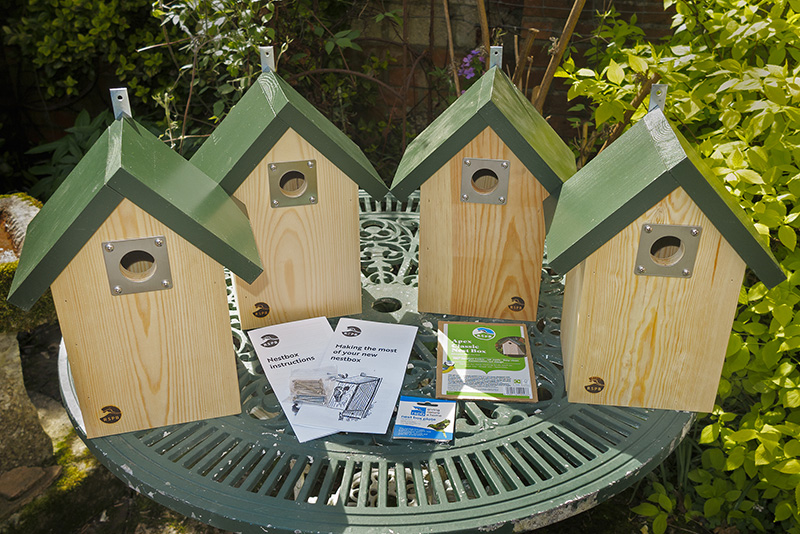
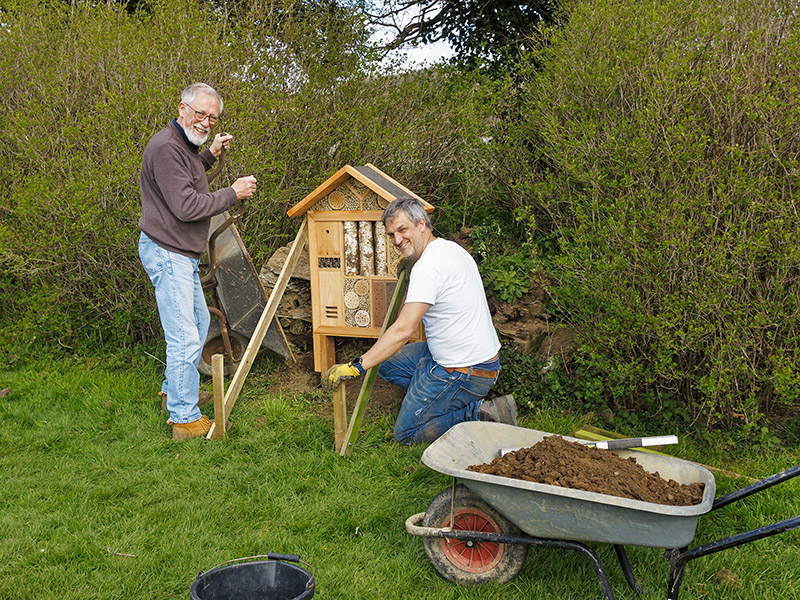
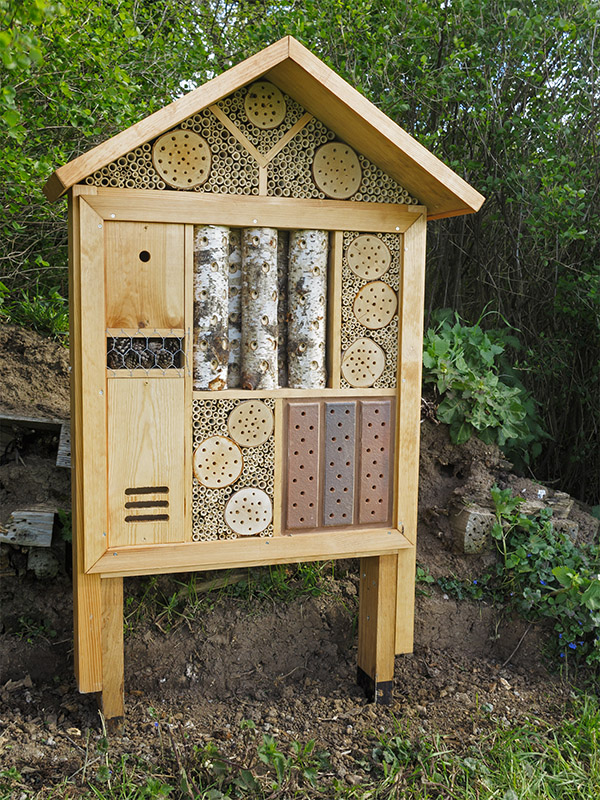
Froyle Wildlife received an EHDC local councillor grant for biodiversity enhancements on Froyle recreation ground. The grant was for 4 bird nest boxes, a large ‘Bee and Insect hotel’, and 250 snowdrop bulbs. Volunteers installed these recently, so thanks to those that helped.
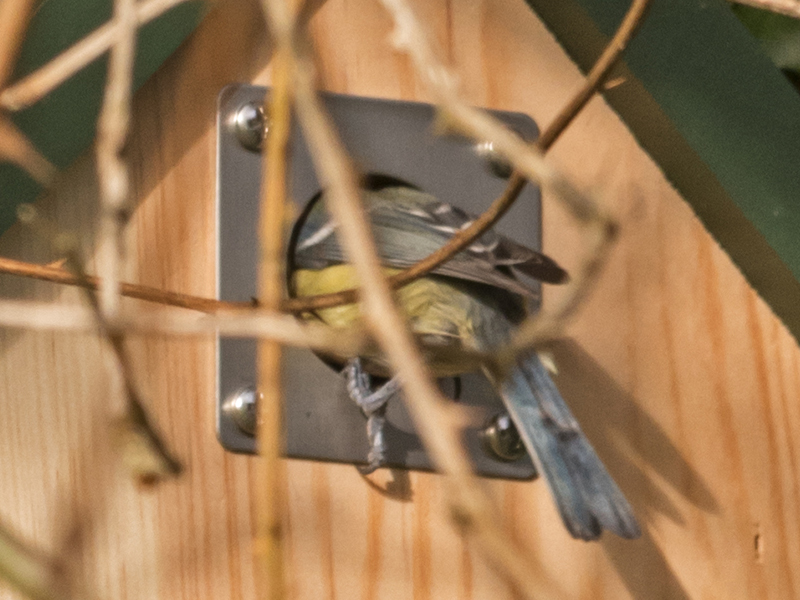
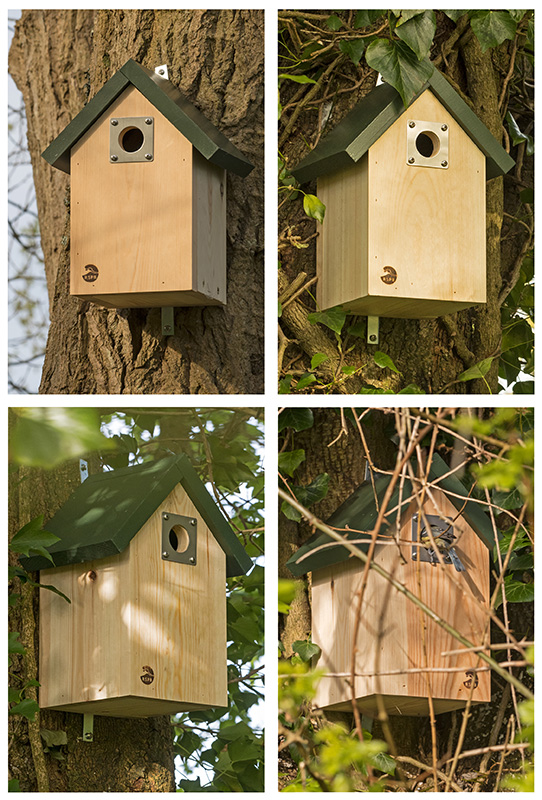
The nest boxes on trees provide more nesting places for small birds such as great tit, sparrows and nuthatch. These were put up at the beginning of April on mature trees at approximately 3m height with a north-westerly aspect (as recommended by RSPB). Within 2 days a blue tit was seen visiting one of the new nest boxes. The new nest boxes supplement those put up in previous years –6 on trees in 2021 and two terraces of 3 sparrow boxes on the wall of Froyle village hall in 2023.
The ‘hotel’ provides solitary bees, pollinators and insects with a sheltered habitat that can be also be seen by anyone. The existing wildflower meadow areas that are nearby will provide nectar to attract pollinators, mainly during May, June and July. The hotel weighing about 25kg was supplied with two stub posts that needed 600mm deep holes and secured with concrete. This was heavy work for 3 volunteers but should ensure a stable installation.
       
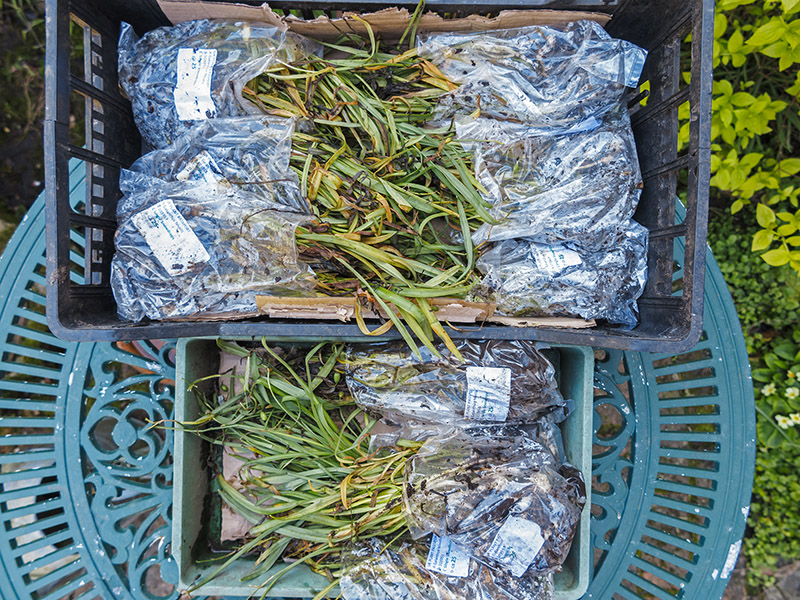
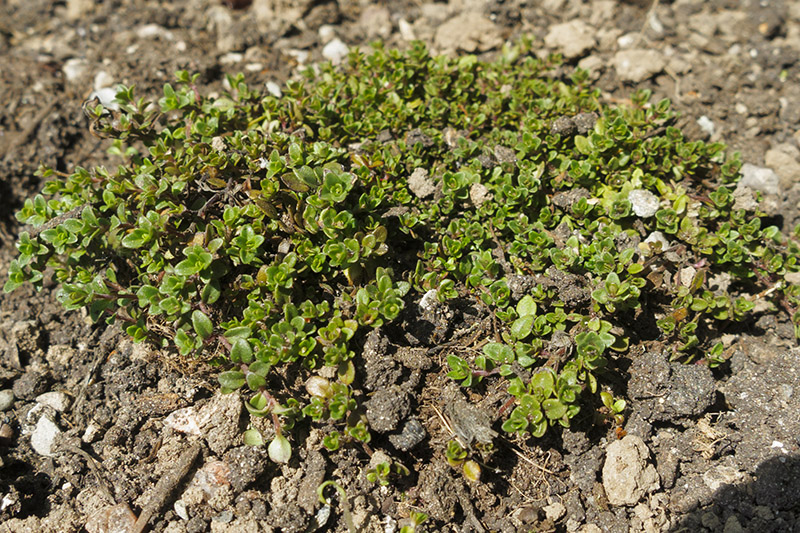
The plantings of snowdrop bulbs in the shade of deciduous trees will provide seasonal interest. They were purchased ‘in the green’ so will not flower until Spring 2027. They were planted in clumps with 4 to 6 bulbs and the clumps in random groups around the perimeter of the recreation ground. Wildflower plants of Thyme, British native species (Thymus polytrichus) were planted near the bee hotel.
These new items supplement the existing wildflower plots (British native species), living willow dome and native tree plantings.
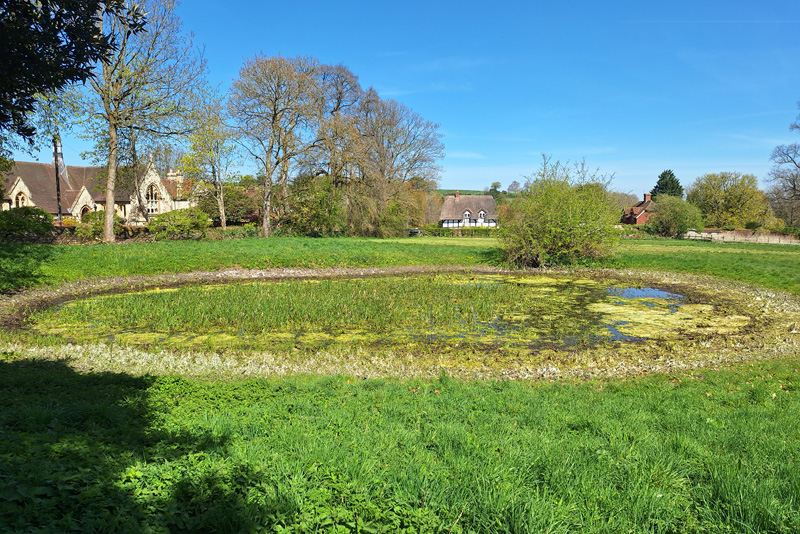
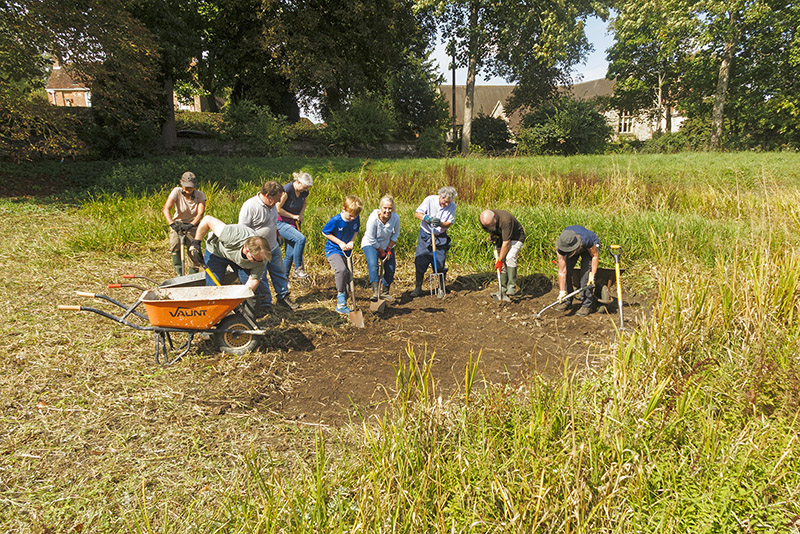


School pond Froyle restoration 6th Sept 2025

Can you help to restore an historic pond in Froyle which has silted up on Saturday 6th September 10am to 1pm?
We plan to remove about a quarter of the vegetation and silt to benefit the known population of great crested newts as well as other protected species. Currently the pond dries out every summer before amphibians can complete their breeding life cycle. For example, in 2025 there was about 20cm depth of water on 11th April and by 4th May just damp ground. Pete West from HIWARG (Hampshire and Isle of Wight Amphibian and Retile Group) will be overseeing the work.
Recommend appropriate clothing, gloves and footwear for digging and moving silt. Please fetch a spade, fork or ideally a wheelbarrow if you can. School pond (also known locally as Dew pond) was shown on the 1845 tithe map of Froyle. The use of heavy machinery to dig out the silt is not a choice because of the historic habitat and any potential damage.
Please let me know if you can come along (even for just 1h) by contacting info@froylewildlife.co.uk.

Summary of the day.

A group of volunteers made a good start to restore the Dew pond, digging out a quadrant. The silt was more difficult than anticipated to remove because of buried stones. The plan is to monitor the pond over next year to see if water is retained for longer. We could then repeat the digging on another quadrant.

We found buried metal including pieces of iron railing, rusted pipe as well as old broken bottle glass, a modern ring pull and a small rusted iron cleat. Sue from Upper Froyle, metal detected the spoil and found a copper coin. The coin was a worn George second half penny, the date was very difficult to read but is probably 1747. So nearly 280 years old!


Why do Moths Matter?

In essence moths are fantastic pollinators, they are a part of nature’s food chain, and they are an early warning indicator for problems in the wider environment.
Moths bring a rich biodiversity with around 2,000 species in Hampshire, and they come in all shapes, sizes, and colours. They are an important element of the food chain, being prey for a wide range of birds, bats and other insectivorous animals. For example, it takes around 15,000 caterpillars to feed one nest of Blue Tit chicks though to fledging.
Recent research shows that moths are more efficient pollinators at night than bees are during the day. Although most moths fly after dark but there are also some that fly during in daylight, such as the Silver Y, Cinnabar and Scarlet Tiger. Surprisingly, there are more day flying moth species in the UK than there are butterflies. Look out for the amazing Hummingbird Hawkmoth that migrates thousands of miles from the Mediterranean to get to the UK in summer.

Moths are indicators of the wider natural environment and when their numbers drop our ecosystem is in trouble. Do you remember that decades ago, if you drove the car at night the windscreen would be plastered with insects -but not today. This decline in numbers is mainly due to climate change, habitat loss and intensive agriculture. You can help to protect our moths by planting wild flowers, growing patches of scrub and rough grass, and turning off lights at night.
For more information see Butterfly Conservation’s website https://butterfly-conservation.org/moths-matter.

Froyle Moth Recording
We recently held two moth identification evenings after dark in Froyle during May 2025. One was held in a Lower Froyle garden and recorded 25 species including Poplar Hawk-moth, Iron Prominent and Brimstone moth. The second was held in the wildflower meadow that surrounds the pond near Gid Lane and recorded 27 species including White Ermine, Nut-tree Tussock and Scorched Wing, see .pdf list. These records are submitted to the National Moth Recording Scheme via the Hampshire County Recorder.

There are some peculiar moth names, for example Rosy Footman, Old Lady, Heart & Dart, Flame Shoulder, Chinese Character and Mother Shipton. All of these have been recorded previously in Froyle with a total of nearly 300 species.


Wildflower areas on Froyle Rec. 2024

The wildflower areas on Froyle recreation ground provide nectar for bees and other pollinators as well as a colourful display for the community. The perennial area had its annual cut at the end of July after flowering well. Volunteers used traditional scything and then removed the cuttings. The Spring sown cornfield annuals then had a colourful display through July and August.
We plan to change the cornfield annuals area to perennials by cultivating the ground this September and then sowing perennial seeds. A mixture of British native species that are different to the original wildflower area are planned thus increasing diversity and flowering times. If you like seeing wildflowers on Froyle rec then do come along to help, for more information contact us.

Here is a list of the planned perennials from seed Agrimonia eupatoria (Agrimony) ; Betonica officinalis (Betony) ; Galium verum (Lady’s Bedstraw) ; Geranium pratense (Meadow Crane’s-bill) ; Knautia arvensis (Field Scabious) ; Leontodon hispidus (Rough Hawkbit) ; Malva moschata (Musk Mallow) ; Onobrychis viciifolia (Sainfoin) ; Poterium sanguisorba ssp sanguisorba (Salad Burnet) ; Prunella vulgaris (Selfheal) ; Ranunculus bulbosus (Bulbous Buttercup) ; Rumex acetosella (Sheep’s Sorrel) ; Red Campion; Wild Carrot; EG6 – Meadow grass mixture ; and from plants -cowslips, marjoram. Please let me know if you have any other favourite British native species that flower in late summer or if you want to grow a few seeds yourself to provide back-up plants in 2025.


Rare insect at Wildlife Pond area July 2024

Visiting the wildflower meadow that surrounds the pond area in July 2024, we spotted an insect that I had never seen before. It stayed long enough to get several photos for identification. It had yellow and black stripes so was it a bee, wasp or hoverfly? No, it was a sawfly with the name Tenthredo schaefferi classed as a vulnerable species. I was unsure of the identification so sought the help of an expert Andrew Green who is the sawfly recorder for the UK, see https://www.sawflies.org.uk/.
The photos were sufficient to tell it was a female sawfly, one of four similar species: arcuata, brevicornis, notha, schaefferi. The species schaefferi is the rarest and the larvae feed either on Tufted Vetch or Field Scabious both of which grow in Froyle Wildlife’s meadow.
The National Biodiversity Network collate species records across the UK and there is only one record in Hampshire (near Southampton) for this sawfly.
So why is one small insect significant? Indicators of habitat and biodiversity!
The food plants of this sawfly were once common in the wider countryside but now tufted vetch and field scabious are scarce in our field edges and hedgerow bottoms.


Newts found in Froyle Ponds 2023

The wildlife pond near Gid Lane has a good population of Great Crested Newts that also breed there. The number of newts has increased substantially since the pond was constructed in 2016 when the first newt was recorded there. By 2021 a professional survey using bottle trapping recorded a maximum count of 28 Great Crested Newts and 23 Smooth Newts. This year 2023, I counted 35 GCN larvae on a warm day in June that were close enough to the water surface for identification with perhaps ten times that number out of sight while hiding in the pond vegetation. This is an outstanding success story achieved by Froyle Wildlife and the volunteers who give their time and effort to maintain the pond and surrounding wildflower meadow.

In the last 12 years there have been a number of newly constructed ponds in Froyle with some in gardens and fields. Froyle Wildlife asked Pete West (from Hampshire Amphibian and Reptile Conservation) to survey selected ponds in April with landowner permission. Smooth Newts and Great Crested Newts were seen in all four ponds surveyed with evidence of breeding in two ponds at Upper Froyle. Unlike frogs and toads, newt eggs are laid singly on submerged vegetation wrapped in a folded leaf (Water Mint is a favourite).
Historically there has been an enormous national decline in their range and abundance over the last century and the Great Crested Newt previously had no records from Lower Froyle but it is now found there as well. The newly constructed ponds don’t just benefit amphibians, they are a magnet for dragonflies, damselflies and other wildlife. Even a small garden pond can help to increase local biodiversity and provide a fascinating window into aquatic life. As the saying goes ‘Just add water’, you could be amazed by the results!


Hedgerows are important for Nature

So why do organisations such as the Wildlife Trusts, the Tree Council, the Woodland Trust and the RSPB all extoll the importance of hedgrows in our landscape?  Hedges are more than an essential refuge for wildlife. Small but mighty, they also clean our air, capture carbon, reduce flooding and give clues to historic land management. In Froyle most rural hedgerows follow the field boundaries shown on the 1847 Tithe Map and are likely to have been hedges for hundreds of years.

Upper Froyle view winter (above)             Lower Froyle view autumn (below)

There are an estimated 500,000 miles of hedgerow in Britain which could be looked on as our largest nature reserve. Hedges come in a variety of shapes and sizes and can include many different species. Rural hedges are often a mix of shrub and tree species, such as hawthorn, blackthorn, spindle, hazel, ash and oak. In more urban and landscaped settings, they are likely to include species like box, yew, privet and holly.

They provide wildlife corridors through a farmed landscape to connect habitat areas. 130 nationally rare species are closely associated with hedges including lichens, fungi and reptiles. Many more use them for food and shelter during some of their lifecycle. Bank vole, harvest mouse and hedgehog all nest and feed in hedgerows as well as birds, while bats use them as ‘commuter routes’ for foraging and roosting.

Some species of birds depend on hedgerows for their survival. At least 30 species nest in hedgerows. According to the RSPB several of these, such as bullfinches and turtle doves, prefer hedgerows more than 4m tall, with lots of trees, whereas whitethroats, linnets and yellowhammers favour shorter hedgerows (2–3m) with fewer trees. Dunnocks, lesser whitethroats and willow warblers prefer medium or tall hedgerows with few trees.

Wrens, robins, dunnocks and whitethroats usually nest low down, but song thrushes, blackbirds, chaffinches and greenfinches nest well above the ground level. Grey partridges use grass cover at the hedge bottom to nest. It is therefore important to manage for a range of hedge heights and tree densities and to maintain a grassy verge at the base of the hedge.

Redwing (photo right) in a Froyle hedgerow
Grassy hedge bottoms and field margins provide nesting material and insect larvae for chicks to feed on. Wild flowers and grasses growing up into a hedge also help to conceal nests from predators. In winter, hedgerows can be feeding and roosting sites for resident birds and winter visitors such as fieldfares and redwings.  Conservation organisations say that no cutting should take place during peak bird nesting season, which runs from March to September. Where possible, delay any maintenance work until January or February, as hedgerow berries provide a valuable autumn and winter food source for birds.

The Wildlife Trusts advise that rural hedges should not be cut every year, as flower buds often form on second-year growth. Trimming hedges on a two or three year rotation, targeting different sections each year, will make sure there are always flowers for pollinators in spring and berries for birds in autumn. Hedges cut every three years can produce two and a half times as much blossom as those cut annually. Rotational cutting can also save time and money that would be invested in annual cutting. The main message for hedges in the landscape is that ‘Big and Blousy’ is better for wildlife than ‘Neat and Tidy’.

Acknowledgment: Some of the text above was copied from information sources.


Wildlife recording:  Can nature count on you?

Wildlife recording:  If you don’t know what you’ve got, then you won’t know when it’s gone

Many of us are interested in wildlife and watch  the species which visit our gardens or favourite local places. Unfortunately, far fewer record the wildlife they see and don’t pass on this valuable information. And that is where you can help! Wildlife records describe the presence, abundance, associations and changes, both in time and space, of wildlife. In its simplest form it is no more than writing down a little information about what you have seen, where and when you saw it and sharing it with County recorders.

In doing so you can help to contribute greatly to local knowledge of our wildlife and habitats. Records can help to establish the distribution and size of populations, and regular recording may enable detection of changes over time. They help to identify the location of rare and locally important species, and can be used to help protect them and their habitats from damage. Over time they help to understand how our environment is changing, for example in response to climate change. Even records of commoner species can be valuable too – what is common today may not be in the future. So why not help by sending in your wildlife records and make the information available to present and future generations. A list of where you can send Hampshire records (depending on the species identified) is available from https://documents.hants.gov.uk/biodiversity/Hampshire-County-Recorder-List.pdf.

Briefly a wildlife record is WHAT you saw, WHERE you saw it, WHEN you saw it and WHO you are. There are websites to help with identification, see links to some at https://www.froylewildlife.co.uk/links/.  The Hampshire Biodiversity Information Centre (HBIC) has an extensive database of records for the County and collates records with partner organisations. HBIC and their partner organisations such as Butterfly Conservation, Hampshire Flora Group and Hampshire Ornithological Society have provided us with past records within the parish of Froyle. Lists of species found in Froyle can be viewed at https://www.froylewildlife.co.uk/recording/species-lists/. Some of these local records were originally submitted by Sue Clark and myself.

A recent talk organised by ACAN ‘Can Nature Count on You?’ introduced HBIC and explained the importance of biological recording, also with a contribution from a local Alton amateur botanist, email altonclimatenetwork@gmail.com if you would like to watch this recorded talk.


Fallen Cedar tree has new life as log seat

A local landmark on a hilltop field in Froyle was the Cedar of Lebanon that stood there for over 150 years as a sentinel tree. The cedar fell during gales in 2020 and an 8ft long section of trunk was kindly donated by Belport in April 2022. Froyle Wildlife arranged for a local chainsaw artist, Jona Cleaver to carve out a wonderful new seat from the log, weighing about 2 tons.

It is located on Froyle recreation ground (with permission from the Parish Council) next to an area of perennial wildflowers and cornfield annuals. A grant from East Hampshire District Council covered our costs for this community project.


How do butterflies survive the winter?

When the weather turns cold, you may wonder what happens to these insects. Winter poses a problem for butterflies as they cannot get warm enough to become active.  They enter a dormant phase either as an egg, larva, pupa or adult insect, dependent upon species.  This isn’t simply a random choice but is a way of ensuring that the insect’s awakening the following year corresponds with the peak availability of its main food source.  Amazingly the Painted Lady avoids winter conditions completely by migrating long distances to regions in North Africa and the Middle East.

Eggs, larvae and pupae tend to be hidden away, though you may find Large White pupae attached to the walls of your house.  Those species that overwinter as dormant adults include Brimstone, Small Tortoiseshell, Peacock and Comma.  The Red Admiral, which has become a common sight in British winters of late, doesn’t enter a proper dormancy but can become active on any suitable sunny days.

The Comma has its name written on the underside in the only white marking, which resembles a comma. When resting with wings closed this butterfly has excellent camouflage, the jagged outline of the wings giving the appearance of a withered leaf, making the butterfly inconspicuous when resting on a tree trunk or when dormant in winter.

The sea urchin-shaped eggs of the Brown Hairstreak are laid singly on the bark of blackthorn, typically on one- or two-year old growth that is in a sheltered area exposed to the sun.  Within the 1mm pin-head sized egg, the larva partially develops before entering hibernation for the winter.  Overwintering eggs are particularly vulnerable to hedge-trimming since they are laid on the youngest growth of the foodplant.

The Orange Tip pupa (or chrysalis) is formed on an upright plant stem that provides a suitable overwintering site, attached by a silk thread girdle.  Green when first formed, the pupa turns light brown to more-closely match its surroundings.  Several crucifers are used as foodplants, especially Cuckooflower in damp meadows and Garlic Mustard along road verges.  It also lays its eggs on Honesty and Sweet Rocket in gardens. The chrysalis will not survive winter if the plant stems are cut down before the adult butterfly emerges in spring.  Leaving part of your garden naturally unkempt helps to benefit other wildlife aswell.

Barry C.